



Warehousing and Distribution

Warehousing and distribution that transforms your operations.

At Trace Consultants we help businesses turn their warehouses, fulfilment centres, and transport networks into high-performing assets. Unlock higher efficiency, lower costs, and faster fulfilment with expert warehouse design consultants who deliver strategies that work in the real world.

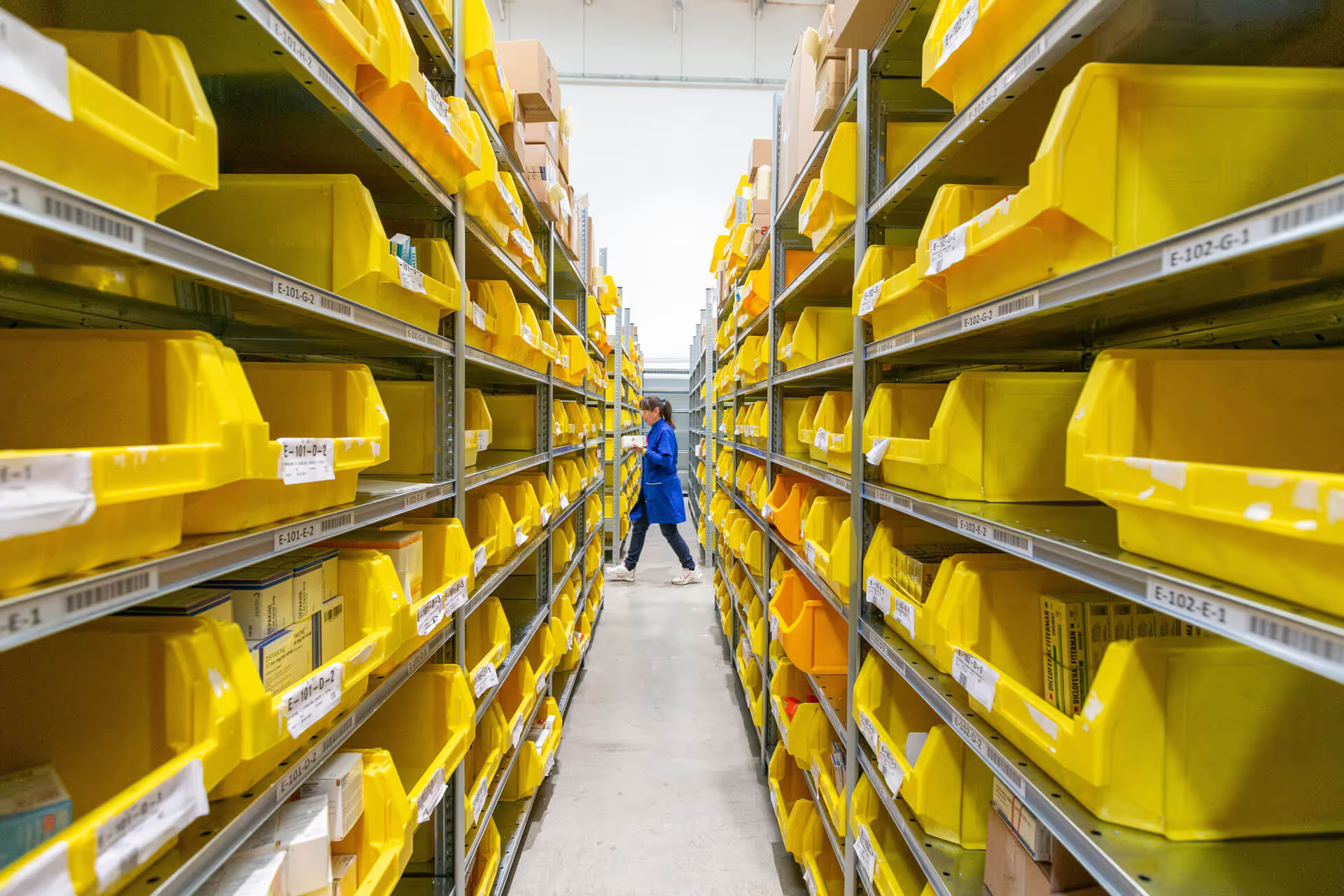
A warehouse of yellow crates

Why warehousing and distribution matters.

In a market where speed, accuracy, and cost efficiency are non-negotiable, your warehouse and transport network can be a powerful competitive advantage or a costly bottleneck. Inefficient layouts, manual processes, and poorly optimised networks slow fulfilment, inflate costs, and frustrate customers.

A data-driven, well-executed warehouse consulting strategy is your edge. By partnering with experienced warehouse design consultants, you can create facilities and distribution networks that work smarter, not harder.

A man in a helmet operating a forklift.

Ways our warehouse consultants can help

Box with a shield

End-to-end warehouse strategy

We design warehouse and distribution centre networks that balance cost, service, and flexibility from footprint optimisation to fulfilment model design.

Ai Automation

Automation & robotics deployment

We implement cutting-edge automation solutions like robotic picking, AS/RS, and AI-driven inventory systems to reduce labour reliance and increase speed.

Blue truck

Transport network optimisation

We streamline freight networks, optimise carrier mix, and implement sustainable delivery solutions that cut costs without sacrificing service.

Sustainable warehouse

Sustainable warehousing solutions

From energy-efficient design to green transport, we align your distribution strategy with your sustainability commitments.

Core service offerings

What our warehousing and distribution service covers:

We offer expert warehouse consulting that combines strategic insight with hands-on implementation.

Warehouse Network Design and Strategy

Creating optimised warehouse footprints and fulfilment strategies that improve service while reducing costs.

What we deliver:

  • Location modelling and site selection (greenfield & brownfield)
  • Consolidation assessments and cost-benefit analysis
  • Omnichannel fulfilment strategies
  • Centralised vs decentralised network planning

Warehouse Automation and Robotics

Assessment, design, and implementation of automation solutions that increase efficiency and accuracy.

What we deliver:

  • Robotics and AGV integration
  • Goods-to-Person and AS/RS systems
  • WMS optimisation and digital workflow automation
  • AI-driven demand planning and replenishment

Transport Strategy and Network Optimisation

Cutting freight costs and improving delivery performance through smarter network and route design.

What we deliver:

  • Freight mode optimisation (road, rail, sea, air)
  • Carrier selection and contract benchmarking
  • Route optimisation and last-mile strategies
  • Fleet management for cost and sustainability

Warehouse and Transport Technology Enablement

Leverageing technology to improve visibility, control, and decision-making.

What we deliver:

  • Low-emission fleet integration
  • Energy-efficient facility design
  • Green packaging and waste reduction strategies
  • Scope 3 emissions reduction planning

Sustainable Warehouse and Transport Solutions

Integrating sustainable design and operations into your network strategy.

What we deliver:

  • WMS & TMS selection and implementation
  • IoT and real-time tracking tools
  • Predictive maintenance for warehouses and fleets
  • Analytics dashboards for performance monitoring

Download our Capability Overview:

A concise, shareable overview of our Warehouse Logistics and Operations capabilities and how we help clients deliver real results.

Thanks for your interest, your capability overview is ready to download below.

Download the Capability Overview (PDF)
*Please ensure you have filled out all required fields.
Warehouse aisle with tall shelves stocked with boxes and workers operating forklifts wearing orange safety vests and white helmets.

Frequently Asked Questions

Common questions about warehousing and distribution.

Ask another question

How do warehouse design consultants help reduce costs?

Warehouse design consultants reduce costs by optimising facility layouts to maximise space utilisation and minimise unnecessary movement. They introduce automation technologies that reduce labour dependency and errors. They also streamline processes such as inventory replenishment, picking, and shipping, which lowers labour costs, reduces waste, and improves transport efficiency.

When should I invest in warehouse automation?

Investing in warehouse automation makes sense when labour shortages, high operational costs, increasing order volumes, or accuracy issues begin to impact your ability to meet customer expectations. Automation can improve throughput, reduce errors, and free up staff for higher-value tasks. Early adoption also future-proofs your operations for continued growth and complexity.

How long does a warehouse redesign project take?

The duration of a warehouse redesign varies based on scope and complexity. A strategic review and layout optimisation can take several weeks, while a full redesign including automation deployment and technology integration can span several months. At Trace Consultants, we tailor timelines to your specific needs and ensure milestones deliver value quickly.

What industries benefit most from warehouse consulting?

Warehouse consulting delivers value across diverse sectors including retail, FMCG (fast-moving consumer goods), manufacturing, healthcare, e-commerce, and government logistics. Any business with inventory handling, order fulfilment, or distribution challenges can improve efficiency, reduce costs, and enhance service with expert warehouse consulting.

Can warehouse consulting improve sustainability?

Absolutely. Warehouse consulting helps organisations design energy-efficient facilities using technologies like LED lighting and solar power. It optimises transport routes and modes to lower emissions and supports circular supply chain practices to reduce waste. These improvements align operations with sustainability goals and regulatory requirements while often generating cost savings.

Insights and resources

Latest insights on warehousing and distribution.

Warehousing & Distribution

WMS vs ERP Warehouse Module 2026

The 2026 decision framework for Australian businesses choosing between an ERP warehouse module and a dedicated Warehouse Management System.

WMS vs ERP Warehouse Module: Which Does Your Business Actually Need?

The most common decision facing Australian operations leaders considering warehouse technology is also the most poorly answered: do we use the warehouse module inside our ERP, or do we buy a dedicated Warehouse Management System? The ERP vendor will tell you their module is enough. The WMS vendor will tell you it absolutely is not. Both have a commercial interest in the answer. Neither is wrong in every case, but neither is right in every case either.

This guide is the decision framework that should sit between those two conversations. It covers the genuine capability difference between an ERP warehouse module and a dedicated WMS, the thresholds at which each becomes the right answer, the vendor pairings that work well in Australian operations, indicative cost ranges, and the SAP-specific situation that has made this decision unavoidable for many businesses through 2026.

The fundamental difference

An ERP warehouse module is software designed to integrate warehouse activity into the broader ERP data model. It sits inside the ERP, shares the ERP data model, and treats the warehouse as one function among many: finance, sales, procurement, manufacturing, warehouse. Its design centre is consistency with the rest of the ERP.

A dedicated Warehouse Management System is software designed from the ground up to direct, optimise, and record physical warehouse activity. It treats the warehouse as the entire problem. Its design centre is operational performance: pick rates, accuracy, throughput, slotting, labour productivity, and automation orchestration.

That difference in design centre shows up in three places that matter. The first is depth of warehouse-specific functionality (slotting algorithms, wave logic, task interleaving, labour standards, voice and vision picking, automation orchestration). The second is the user experience for warehouse operators (purpose-built mobile RF interfaces with task-directed workflows versus general-purpose ERP screens adapted for scanning). The third is the ability to handle the operational complexity of high-volume, multi-channel, or automated warehouses.

For simple warehouses, the difference does not matter much. For complex warehouses, it matters enormously.

When the ERP warehouse module is the right answer

The ERP warehouse module is typically the right answer when several of the following are true. Single-site or low-complexity multi-site operations. Under approximately 2,000 active SKUs. Order volumes that are predictable and not seasonally peaked. Limited or no warehouse automation. Standard pick-pack-ship flows without complex value-add or kitting. No 3PL or multi-client requirements. The warehouse is one function inside a broader business rather than the core operating engine.

In these conditions, the integration benefit of an ERP-embedded module (one data model, no integration build, native finance and inventory consistency, lower total cost) typically outweighs the capability gap. The warehouse is simple enough that you do not need the extra capability a dedicated WMS provides, and you would be paying for headroom you will not use.

The leading ERP-embedded warehouse modules considered in the Australian market include SAP EWM (embedded in SAP S/4HANA), Oracle NetSuite WMS, Microsoft Dynamics 365 Warehouse Management, and Oracle Fusion Warehouse Management. Each has its own strengths and limitations, which are covered later.

When a dedicated WMS becomes the right answer

A dedicated WMS becomes the right answer once any of the following thresholds are crossed. Active SKU count beyond approximately 2,000. Multi-site distribution where network-level inventory visibility, transfer optimisation, and consistent process management matter. Warehouse automation (conveyors, sortation, AS/RS, AMRs, goods-to-person systems, putwalls) that needs orchestration. Omnichannel fulfilment where the same DC handles bricks-and-mortar replenishment, ecommerce, and wholesale. 3PL operations with multi-client architecture, billing, and EDI requirements. Regulated environments (health, aged care, defence, food) requiring strict lot, batch, serial, and chain-of-custody control. High-throughput operations where pick rate, accuracy, and dock-to-stock time are commercially critical.

The compounding rule matters here. Crossing one threshold marginally does not necessarily require a dedicated WMS. Crossing two or three at once usually does. A single-site mid-market FMCG distributor with 3,000 SKUs but no automation, simple wholesale flows, and predictable volumes might be perfectly served by an ERP module. A single-site retailer with 1,500 SKUs but heavy omnichannel ecommerce volume, automation, and intense peaks will almost certainly outgrow an ERP module quickly.

The 2025 Gartner Magic Quadrant for Warehouse Management Systems identified six Leaders in the dedicated WMS space: Manhattan Associates, Blue Yonder, SAP, Oracle, Infor, and Infios (the new brand for what was Körber Supply Chain Software, rebranded in March 2025). These are the platforms most often considered when the ERP module is no longer enough.

The SAP situation: a forced decision through 2026

For Australian businesses running SAP, the WMS-versus-ERP-module question has become unavoidable. Mainstream maintenance for SAP Warehouse Management (LE-WM) ended on 31 December 2025, with SAP providing a final transition window to 31 May 2026 for specific on-premise customers per published SAP guidance. Beyond that, SAP WM customers must move to one of three options: SAP S/4HANA Stock Room Management (a basic warehousing continuation built on the LE-WM data model, with limited future investment per SAP's published position), SAP Extended Warehouse Management (SAP's strategic warehouse management product, embedded in S/4HANA or deployed as a decentralised solution), or a third-party WMS replacing the SAP warehouse functionality entirely.

This is one of the cleanest forced decisions on this question in the Australian market. SAP WM customers face a real choice in 2026: invest in Stock Room Management for basic continuation, step up to SAP EWM for SAP's strategic option, or use the migration as the trigger to evaluate whether a best-of-breed WMS is the right long-term answer. The right answer depends on warehouse complexity, automation roadmap, integration architecture, and whether the broader S/4HANA transformation is a forcing function or a constraint.

For Australian organisations facing this decision now, the worst answer is delay. The migration window is not large, the SAP EWM consulting market is finite, and the cost of running unsupported software past the deadline scales quickly.

What the major ERP warehouse modules actually do

The capability gap between ERP warehouse modules and dedicated WMS platforms has narrowed over the past decade. ERP modules are more capable than they were five years ago. Dedicated WMS platforms have also moved on, so the gap remains, but the location of the gap has shifted.

SAP Extended Warehouse Management (EWM) is SAP's strategic warehouse management product and is positioned by SAP as the long-term replacement for SAP WM. EWM is genuinely capable and is recognised in the Gartner Magic Quadrant as a Leader. It is particularly strong in process manufacturing, life sciences, chemicals, and industries with strict regulatory and traceability requirements. The trap with EWM is assuming it is the "free" option because it sits inside SAP. Implementation effort and configuration complexity are comparable to standalone WMS platforms, and the Australian SAP EWM consulting market is thinner than the broader S/4HANA market.

SAP S/4HANA Stock Room Management is SAP's continuation option for organisations on SAP WM that need basic warehouse functionality going forward. It reuses major parts of the LE-WM data model and covers basic warehouse processes. Per SAP's published roadmap, there is no further investment planned in Stock Room Management as EWM is the strategic solution. For organisations with very simple warehouses and no growth in complexity, Stock Room Management can be the pragmatic choice. For most others, it is a stop-gap.

Oracle NetSuite WMS is a warehouse management module within the NetSuite ERP platform that supports core processes including receiving, putaway, RF-scanned picking and packing, wave management, cycle counting, and shipping integration. For businesses already running NetSuite as their ERP, it provides a tightly integrated option with no separate integration to build. The publicly documented limitations cluster around 3PL multi-client operations, deep automation and robotics integration, advanced customisation, and very high-volume multi-location networks. For standardised single-site or low-complexity multi-site operations on NetSuite, it is a credible answer. For complex operations, the limitations show up quickly.

Microsoft Dynamics 365 Warehouse Management is the warehouse management capability within Dynamics 365 Supply Chain Management. It has matured significantly and is increasingly considered for mid-market warehouses where the broader organisation is standardised on the Microsoft stack. Its capability is credible for standard distribution operations and has improved automation integration in recent releases.

Oracle Fusion Warehouse Management is Oracle's cloud-native warehouse management capability, separable from but well-integrated with Oracle Cloud ERP. It is a credible enterprise option, particularly for organisations already standardised on Oracle Cloud applications.

The pattern across all four is the same: the modules handle standard warehouse operations well and integrate natively with the ERP. They struggle, to varying degrees, with deep automation orchestration, 3PL multi-client complexity, high-throughput omnichannel operations, and the most specialised industry-specific use cases. Whether those struggles matter depends on the warehouse.

The decision framework: six tests

When advising Australian operations leaders on this decision, six tests typically separate "ERP module is enough" from "dedicated WMS required".

The SKU and throughput test. Under approximately 2,000 active SKUs and stable order volumes is typically ERP-module territory. Beyond that, the decision becomes more nuanced. Beyond approximately 10,000 active SKUs or high-volume daily order counts, a dedicated WMS is usually required.

The network test. Single-site or two-site low-complexity networks are typically ERP-module territory. Multi-site networks with significant inter-site transfer, network-level inventory optimisation, or differentiated DC roles usually need a dedicated WMS.

The automation test. Manual or lightly mechanised warehouses can run on ERP modules. Anything orchestrating conveyors, sortation, AS/RS, AMRs, or goods-to-person systems is typically a dedicated WMS decision. Some ERP modules can integrate to automation, but dedicated WMS platforms are usually purpose-built for it.

The channel complexity test. Single-channel wholesale or B2B distribution can typically be handled by an ERP module. Omnichannel fulfilment combining store replenishment, ecommerce, and wholesale from the same DC almost always benefits from a dedicated WMS, particularly for waveless or order-streaming fulfilment patterns.

The 3PL test. If you are a Third-Party Logistics provider, the answer is almost always a dedicated WMS with multi-client architecture. ERP warehouse modules are not designed for multi-client billing, EDI breadth, and per-client workflow configuration. For more on the 3PL-specific WMS decision, our Warehousing and Distribution practice covers the operational lens that informs this choice.

The regulatory test. Industries with strict lot, batch, serial, expiry, recall, chain-of-custody, or audit-trail requirements (health, aged care, food, defence, life sciences) often benefit from a dedicated WMS or from one of the more capable ERP modules (notably SAP EWM and Oracle Fusion Warehouse Management) configured to the regulatory requirement.

The right approach is to walk all six tests honestly. If five or six come back "simple", the ERP module is usually right. If three or more come back "complex", a dedicated WMS is usually right. If the answer is borderline, the deciding factor is typically the five-year roadmap. Buying for today's complexity is cheaper. Buying for the complexity coming in 24 to 36 months is wiser.

Vendor pairings: which dedicated WMS pairs well with which ERP

If the decision goes to a dedicated WMS, integration architecture becomes the next consideration. Some pairings are smoother than others.

SAP S/4HANA ERP paired with SAP EWM is the natural pairing where SAP is the strategic ERP standard. Where the warehouse complexity warrants more than EWM offers, or where the local EWM partner ecosystem is a constraint, organisations on S/4HANA also consider Manhattan Active Warehouse Management, Blue Yonder Warehouse Management, or Infios. All three have established integration patterns with S/4HANA.

Oracle Cloud ERP pairs naturally with Oracle Fusion Warehouse Management. Where complexity exceeds Oracle Fusion's capability, Manhattan and Blue Yonder are the dominant alternatives, with proven Oracle integration.

Oracle NetSuite pairs naturally with NetSuite WMS for simple operations. For more complex operations or 3PL use cases, NetSuite is most commonly paired with Microlistics, CartonCloud (for SME 3PLs and transport operators), Made4net, or Softeon.

Microsoft Dynamics 365 pairs naturally with Dynamics 365 Warehouse Management. For greater capability, Dynamics 365 is increasingly paired with Manhattan Active WM, Blue Yonder, or Infios at the enterprise end, and Microlistics at the mid-market.

Smaller ERPs (MYOB, Xero, Cin7, Unleashed, Pronto, Greentree, Attaché, and similar) typically lack credible embedded warehouse modules for anything beyond very simple operations. CartonCloud is a common pairing for SME 3PLs and transport operators. .Store, the Trace WMS platform, is designed specifically for mid-sized Australian businesses needing structured warehouse management with any ERP, on a low-code, ERP-agnostic architecture.

The integration architecture is rarely the deciding factor on its own, but it is rarely irrelevant. Smooth integration patterns reduce implementation risk, lower ongoing support cost, and improve the speed of future changes. Worth weighing in the selection.

Indicative cost comparison

Cost comparisons between ERP modules and dedicated WMS platforms are easy to do badly. The five-year total cost picture rarely matches the headline.

For an ERP warehouse module activated as part of an existing ERP environment, the incremental cost is typically the user licensing for warehouse operators, an implementation effort to configure the module and connect to RF devices, and potentially additional licensing for advanced capabilities. Indicative ranges sit at hundreds of thousands rather than millions for most mid-market deployments. For organisations going through an ERP transformation, the warehouse module configuration is often folded into the broader programme.

For a dedicated WMS implementation, the cost ranges previously published in our Australian WMS Buyer's Guide typically run $400,000 to $1.2 million for a mid-market single-site implementation, $1.5 million to $4 million for multi-site mid-market rollouts, and $5 million to $20 million-plus for enterprise-scale national programmes. Add 15 to 25 per cent of the total for integration to the ERP, the TMS, the ecommerce platform, and any automation kit.

On a five-year total cost of ownership basis, the gap between an ERP module and a dedicated WMS narrows considerably once integration, ongoing licensing, internal support, and the operational cost of complexity-driven workarounds are all in scope. The ERP module is rarely as cheap as it first appears. The dedicated WMS is rarely as expensive as it first appears. Both should be modelled properly before the decision is made.

Common failure modes in this decision

In our experience advising Australian operations leaders, three failure modes recur in this decision.

Choosing the ERP module by default because it is "already paid for". It is not. The implementation effort, the user licensing, the operational compromises required to fit the warehouse to the module, and the cost of later having to replace it are all real. The ERP module should win on fit, not on assumed inclusion.

Choosing a dedicated WMS for an operation that does not need it. A small single-site distributor with 1,500 SKUs, stable B2B volumes, and no automation buying a Tier 1 enterprise WMS will absorb capital and leadership attention they did not need to spend. The ERP module would have served them well.

Underestimating integration when going dedicated. A dedicated WMS that does not talk cleanly to the ERP, the TMS, and the ecommerce platform is worse than no WMS at all. Integration is not a checkbox. It is a designed, tested, performance-validated workstream that typically accounts for 15 to 25 per cent of programme cost.

Avoiding all three requires honest assessment of the operation today, the operation in five years, and the architecture that supports both.

How Trace Consultants can help

Trace Consultants advises Australian organisations across the full warehouse technology journey, including the WMS-versus-ERP-module decision. Our positioning is deliberate: vendor-agnostic, partner-led, and senior on every engagement.

Operating model and warehouse strategy. Before any technology decision, we work with the leadership team to define the future-state warehouse operating model: network footprint, role of each DC, target service levels, automation roadmap, and the role technology plays in supporting the commercial strategy. This sits inside our Strategy and Network Design practice.

Technology selection. We run vendor-agnostic selections across ERP warehouse modules and dedicated WMS platforms. Our role is to test the operation against the capability of both, identify the right answer for the next five years, and run a structured selection that includes scripted demonstrations, partner evaluation, and a defensible commercial outcome. This is delivered through our Technology practice.

Implementation oversight and programme assurance. The buyer-side role through implementation is as important as the selection itself. We sit on the client side of the table through detailed design, build, testing, and go-live, providing assurance on the partner, the technology, the data, the integration, and the change. This is delivered through our Project and Change Management practice.

Warehouse operations and labour productivity. Our Warehousing and Distribution practice covers the operational layer underneath the technology: DC design, slotting, pick path optimisation, labour productivity, and automation strategy.

.Store: Trace's WMS for mid-sized Australian businesses. Where the right answer is a structured, fast-to-deploy, ERP-agnostic platform sitting outside the ERP module, we offer .Store. Sitting alongside our broader operational technology suite, .Store is part of our Technology offering.

Explore our Warehousing and Distribution services →

Speak to an expert at Trace →

Where to begin

If you are early in this decision, the first step is not a vendor demo. The first step is the six-test honest assessment: SKU and throughput, network, automation, channel complexity, 3PL, regulatory. Followed by the five-year roadmap question: where does the operation need to be in 24 to 36 months, and what does that demand of the technology?

If both point to the ERP module, configure and go. If both point to a dedicated WMS, run a structured selection. If the answer is borderline, the deciding factor is usually the trajectory of complexity, not today's state.

Frequently asked questions

Do I need a WMS or can I extend my ERP? ERP warehouse modules are typically credible for simple, low-volume, single-site operations with limited automation and under approximately 2,000 active SKUs. Once you cross multiple complexity thresholds (multi-site, automation, omnichannel, high SKU count, 3PL, regulatory complexity), a dedicated WMS becomes the right answer.

Is SAP EWM the right choice if we run SAP S/4HANA? Often, but not automatically. SAP EWM is genuinely capable and is recognised as a Gartner Magic Quadrant Leader. The trap is assuming it is the cheap or low-risk option because it sits inside SAP. Implementation effort, configuration complexity, and partner capability are the deciding factors. Manhattan, Blue Yonder, and Infios are credible alternatives for S/4HANA customers where the warehouse complexity warrants more than EWM offers.

What is the difference between SAP WM and SAP EWM? SAP WM (LE-WM) was SAP's classic warehouse management module, integrated into ECC and supported in S/4HANA compatibility mode. SAP EWM is SAP's strategic warehouse management product, with significantly broader functional capability covering complex slotting, labour management, automation integration, and advanced fulfilment patterns. Per SAP's published roadmap, EWM is the long-term strategic solution.

What happens to SAP WM after 2025? Mainstream maintenance for SAP LE-WM in S/4HANA compatibility mode ended on 31 December 2025, with a final transition window to 31 May 2026 for specific on-premise customers per published SAP guidance. After that, customers must move to SAP S/4HANA Stock Room Management, SAP EWM, or a third-party WMS.

Does NetSuite WMS work for a 3PL? It is generally not the recommended answer for serious 3PL operations. NetSuite WMS is documented as having limitations around multi-customer billing, contract-specific workflows, value-added services, and high-volume multi-location 3PL scenarios. Most NetSuite-based 3PLs pair NetSuite with a dedicated 3PL WMS like CartonCloud, Microlistics, or one of the enterprise platforms.

When does an ERP warehouse module stop being enough? Typically when several complexity thresholds compound. Active SKUs beyond approximately 2,000, multi-site networks requiring optimisation, warehouse automation that needs orchestration, omnichannel fulfilment, 3PL operations, or regulatory environments requiring deep traceability. Crossing one threshold marginally rarely forces the decision. Crossing two or three usually does.

Is Microsoft Dynamics 365 Warehouse Management capable enough for a mid-market business? It can be, for standardised warehouse operations on the Microsoft stack. Its capability has matured significantly. For complex automation, omnichannel, or 3PL use cases, organisations typically pair Dynamics 365 with a dedicated WMS like Manhattan Active WM, Blue Yonder, Infios, or Microlistics rather than relying on the embedded module.

Will a dedicated WMS deliver more value than the cost difference? It depends on warehouse complexity. For simple operations, no. For complex operations, often yes. The value drivers are pick accuracy, throughput, labour productivity, inventory accuracy, and the operational data needed to manage the warehouse as a precision operation. Modelling the value case requires honest assessment of current performance versus achievable performance, not vendor claims.

Can I start with the ERP module and move to a dedicated WMS later? Yes, and many organisations do. The risk is that the operational data, master data hygiene, and process discipline built on the ERP module may not transfer cleanly to the dedicated WMS. The implementation effort can be larger than a greenfield WMS deployment because legacy assumptions and workarounds need to be unwound. Worth weighing in the decision.

The WMS-versus-ERP-module decision is rarely binary, and the wrong framing of the question creates the wrong answer. The right framing starts with the operation, walks the complexity tests honestly, and works forward to the five-year position. Then, and only then, does the platform conversation start.

If you are facing this decision now, particularly under the SAP WM transition pressure, the rigour of the assessment matters more than the choice between two credible options.

Explore our Warehousing and Distribution services →

Speak to an expert at Trace →

Related reading: Warehousing and Distribution · Technology · Strategy and Network Design · Project and Change Management


Warehousing & Distribution

Best WMS for Australian 3PLs 2026

What makes a 3PL WMS different, how the major platforms compare for Australian 3PLs in 2026, and the selection framework that protects your implementation.

Best WMS for Australian 3PLs: A Vendor Comparison and Selection Guide

For most businesses, a Warehouse Management System is back-office infrastructure. For a Third-Party Logistics provider, the WMS is the product. It is what you sell, how you sell it, how you bill it, and what your clients judge you on. Get the WMS right and you can scale clients faster, run higher margins, and win business off competitors. Get it wrong and you are stuck servicing every new client with custom workarounds, leaking margin through billing errors, and losing clients to 3PLs whose platforms make their lives easier.

The Australian 3PL market is unforgiving. Margins are thin, client expectations are rising, ecommerce growth has rewritten what fulfilment means, and a generation of warehouse-savvy clients now expect cloud portals, EDI integration, and real-time visibility as table stakes. This guide cuts through the noise on WMS selection for Australian 3PLs in 2026: what makes a 3PL WMS different, who the credible vendors are at each tier, what to actually evaluate, what it costs, and where most 3PLs come unstuck.

What makes a 3PL WMS different from a standard WMS?

A standard WMS manages one business operating its own warehouse for its own purposes. A 3PL WMS manages many businesses operating in the same warehouse, with different rules, different stock owners, different rate cards, different reporting requirements, and different integrations. That single architectural difference creates a long list of capability requirements that standard WMS platforms either do not have, or have bolted on as an afterthought.

A 3PL WMS must credibly support:

Multi-client architecture. Each client's stock, orders, locations, business rules, and data are logically partitioned. One client's audit cannot see another client's data. SKU masters, units of measure, and product hierarchies are per-client. Business rules (FEFO, FIFO, allocation logic, replenishment triggers) are per-client. This is not a UI feature. It is a data model decision that has to be made early in a platform's design life.

Activity-based billing engine. Storage fees by pallet-day, location-day, or cubic-metre-day. Handling fees by line, unit, or carton. Value-add services like labelling, kitting, repackaging, and returns processing. Surcharges for after-hours, hazardous goods, refrigerated handling. Minimum monthly fees and tiered volume rates. Without a credible billing engine, the finance team is doing it in Excel, revenue is being captured incompletely, and there are too many client conversations about what was actually performed.

Client portal and self-service. Each client expects a branded view of their own stock, their own orders, their own service performance, and their own billing data. They want to place orders, run reports, and track shipments without picking up the phone.

EDI and API breadth. Every client comes with their own systems. A 3PL WMS will be integrating with NetSuite, Shopify, BigCommerce, Magento, SAP, Oracle, Dynamics, Cin7, Unleashed, Xero, MYOB, and a long tail of bespoke ERPs. The platform has to make new client integration cheap and fast, because client onboarding velocity is a primary growth lever for 3PLs.

Per-client service level reporting. DIFOT, order accuracy, dispatch time, inventory accuracy, dock-to-stock time, and exception rates need to report per client, not just at warehouse level. Quarterly business review conversations live or die on this data.

Configurable workflows per client. One client wants paper pick slips with a wet signature. Another wants voice-directed picking. A third wants RF scan with mandatory weight capture. A 3PL WMS has to handle all three concurrently in the same warehouse without bespoke development for each new arrangement.

If a vendor shortlist includes platforms that do not credibly do all six of these, they are not 3PL WMS platforms. They are warehouse management systems that are about to be misused.

The Australian 3PL WMS vendor landscape in 2026

Australia's 3PL WMS market splits into three tiers based on the scale and complexity of the 3PL operation. The decision is not "which is best". The decision is "which tier matches the business now, and where will it be in five years".

Tier 1: enterprise 3PL platforms

These are the platforms running some of the largest 3PL networks globally. In the Australian context, they are credible for 3PLs with national or multi-country operations, large enterprise clients with significant integration depth, and the scale to justify multi-million-dollar implementations.

Manhattan Active Warehouse Management is the cloud-native flagship from Manhattan Associates. Manhattan was named a Leader in the 2025 Gartner Magic Quadrant for Warehouse Management Systems and is widely regarded among consultants and analysts as one of the deepest platforms for complex, high-volume, multi-tenant 3PL operations. Its publicly documented capabilities include client partitioning, order streaming for waveless fulfilment, and AI-driven slotting and labour management. It is also expensive and demands a sophisticated buyer. For 3PLs running national networks for blue-chip retail and FMCG clients, it is hard to beat.

Manhattan SCALE is the second Manhattan product relevant to 3PLs, particularly for mid-to-large 3PLs that need deep billing capability via Manhattan Billing Management. SCALE remains in active use across many 3PLs internationally and continues to be supported alongside Manhattan Active WM.

Blue Yonder Warehouse Management was named a Leader in the Gartner Magic Quadrant for Warehouse Management Systems for the fourteenth consecutive time in 2025, and was publicly announced as a preferred WMS provider for GXO. For Australian 3PLs aligned with global platform standards, particularly those servicing multinational clients, Blue Yonder is a credible enterprise option.

Infios WMS is the new brand for what was Körber Supply Chain Software, which rebranded as Infios in March 2025 at a launch event in Melbourne. The Infios WMS portfolio includes platforms with a long heritage in 3PL deployments globally (including HighJump-derived products). Infios also now includes MercuryGate TMS following the 2024 acquisition, which matters for 3PLs running integrated warehouse-transport operations.

Tier 2: mid-market and Australian-relevant 3PL specialists

Microlistics WMS 3PL is one of four product variants from Microlistics (alongside Enterprise, Chilled, and Express), and is specifically designed for multi-site, multi-client 3PL operations. Microlistics is Melbourne-headquartered and has been owned by ASX-listed WiseTech Global since 2017. It is one of the few WMS platforms designed and built in Australia for the Australian market, with local engineering, local support, and integration into the WiseTech CargoWise ecosystem. For Australian 3PLs in the mid-market segment, particularly those with cold chain, multi-site, or freight-forwarding-adjacent operations, Microlistics is typically a default consideration.

Tecsys Elite WMS was positioned as a Challenger in the 2025 Gartner Magic Quadrant. Tecsys publicly positions the platform around healthcare, 3PL, and complex distribution. For 3PLs with healthcare clients carrying strict regulatory, traceability, and chain-of-custody requirements, Tecsys is one of the few platforms in market that directly targets that complexity.

Softeon and Made4net are credible mid-market options with international 3PL deployments, particularly for ecommerce-heavy 3PLs requiring high-throughput pick-pack operations and modern automation orchestration. Their Australian footprint is smaller than the platforms above, which is worth weighing in any selection.

Tier 3: cloud-native SME 3PL platforms

CartonCloud is an Australian-built cloud platform designed specifically for small-to-mid 3PLs and transport operators. The platform combines WMS, TMS, and billing in a single integrated cloud product, prices on a subscription model suited to small 3PLs, and is positioned around fast client onboarding. For Australian 3PLs at the smaller end of the market, particularly those with a transport-and-warehouse blend, CartonCloud is often the right answer. It can also be a credible component of a hybrid model where SME clients are serviced on CartonCloud and enterprise accounts on a Tier 1 platform.

.Store is the Trace Consultants WMS platform, built for mid-sized Australian businesses including 3PLs that need structured warehouse management without enterprise-scale complexity or cost. It is built on low-code principles, is ERP-agnostic, and sits inside Trace's broader operational technology suite covering planning, workforce scheduling, DIFOT tracking, and network analytics.

Microsoft Dynamics 365 Supply Chain Management is increasingly considered by businesses standardised on the Microsoft stack. For complex multi-client 3PL operations, it usually requires additional capability layered on top, and is more commonly seen as an in-house logistics platform than a pure 3PL WMS.

What to actually evaluate beyond the feature list

Standard vendor demos focus on functional capability. For a 3PL, functional capability is necessary but not sufficient. The factors that determine whether a WMS investment pays back are operational and commercial.

Client onboarding speed. One of the biggest constraints on 3PL growth is how fast a new client can be stood up. Ask each vendor: from contract signature with a new client, how many calendar days until they are live and shipping? Ask for references. For a simple client, the answer should be days. For a complex one, weeks. If the answer is two to three months as standard, the platform is a growth handbrake.

Integration template library. A modern 3PL WMS should have pre-built integration patterns or templates for the major ecommerce platforms (Shopify, BigCommerce, Magento, WooCommerce), the major ERPs (NetSuite, SAP, D365, Oracle, Cin7, Unleashed), the major freight platforms (carrier integration layers), and the major EDI standards. Each custom integration avoided per client is a faster onboarding and a higher gross margin.

Billing flexibility and audit trail. Can the platform bill a client for storage at one rate in one location and another rate in another, with seasonal surcharges, minimum monthly fees, and tiered volume discounts? Can value-add services be charged with full audit traceability? Can a billing run itemise every charge so a client can audit it line by line? If any of these is "with customisation", it will hurt later.

Client portal capabilities. Is the portal white-labelled? Can each client get a branded URL? Can clients enter orders, run reports, raise queries, and access ePOD documents? Is it mobile-friendly? In 2026, 3PL clients increasingly expect this as a default, not a premium.

Local implementation partner depth. A platform with limited local consulting capacity is a risk regardless of how good the global product is. The named consultants who will deliver the implementation, their CVs, and references from comparable Australian projects should all be part of the evaluation. The platform might be excellent. If the local delivery team is thin, the project will struggle.

Roadmap alignment. Where is the vendor investing? AI-driven slotting, robotic orchestration, predictive labour, embedded carbon reporting? A three-year roadmap should align with where the 3PL is going.

Commercial flexibility. Most 3PLs do not have predictable volumes. Volumes scale with new client wins and contract losses. Subscription models that scale with usage are usually better than fixed enterprise licences. This is worth negotiating hard.

For a broader view on how WMS selection fits into operating model design, the Warehousing and Distribution practice page covers the operational lens we apply to every WMS engagement.

Indicative WMS cost ranges for Australian 3PLs

Cost depends on scale, complexity, platform tier, and the depth of integration and automation in scope. The ranges below are indicative based on typical Australian programmes and are intended as a planning guide, not a quotation.

Small 3PL (single site, under 20 active clients, under $20 million revenue): cloud platforms in this segment typically sit in the $30,000 to $150,000 per year subscription range, with implementation services of $50,000 to $200,000 depending on configuration and integration scope.

Mid-market 3PL (multi-site, 20 to 100 active clients, $20 million to $100 million revenue): platform implementations typically run $500,000 to $2.5 million all-in, with annual platform costs running 15 to 25 per cent of implementation cost on an ongoing basis.

Large 3PL (national or multi-country, 100-plus active clients, $100 million-plus revenue): Tier 1 implementations typically run $2 million to $10 million-plus depending on the number of sites, the depth of integration, and the level of automation being orchestrated.

These ranges include software, implementation services, integration build, data migration, training, hardware (scanners, mobile devices, printers), and contingency. They do not include the operational cost of the change programme inside the business: project team time, client communications, parallel running, and the productivity dip during stabilisation. Budget another 20 to 30 per cent for those costs.

The cost line that 3PLs most consistently underestimate is integration. A 3PL with 40 active clients has at least 40 active integrations, and each new client adds one or two more. The right thing to budget for is integration capability over the life of the platform, not just integration project cost at go-live.

Where 3PL WMS implementations underdeliver

In our experience advising Australian operations leaders, 3PL WMS implementations underdeliver for five recurring reasons. None of them are about the platform.

Billing configuration is underestimated. 3PLs often assume their billing rules will configure straightforwardly. They rarely do. Real-world 3PL rate cards have legacy quirks, client-specific exceptions, and grandfathered arrangements that are not in any contract. Cleaning up the rate card during implementation is mandatory work and is typically larger than initial estimates suggest.

Client onboarding effort is underestimated. Migrating active clients onto a new WMS is a series of mini-projects, not one project. Each client has integrations to rebuild, data to migrate, workflows to configure, and people to retrain. Phasing the cutover by client is usually smarter than a big-bang go-live, and very few implementation plans start that way.

Integration debt accumulates. Treating client integrations as one-off project tasks rather than building a re-usable integration framework. The first client integration takes a week. The fortieth should take days. If it does not, the platform investment is being undermined by accumulating technical debt.

The operating model is not redesigned. Implementing a new WMS without redesigning the operating model means digitising current workarounds. Implementation is the opportunity to reset pick strategy, slotting, replenishment, and labour model. Doing both at once is harder, but doing the WMS without the operating model rarely captures the value.

Client communication is treated as an afterthought. 3PL clients are paying for service continuity. A WMS change that disrupts their experience without proper communication damages relationships. A 3PL WMS go-live is a client management exercise as much as a technology exercise.

The common thread: these are leadership, design, and delivery challenges, not technology challenges.

How Trace Consultants can help

Trace Consultants advises Australian 3PLs across the full WMS journey, from operating model design through vendor selection to implementation oversight and post-go-live optimisation. Our positioning is deliberate: vendor-agnostic, partner-led, and senior on every engagement.

3PL operating model and proposition design. Before any vendor conversation, we work with the leadership team to define the operating model: target client segments, service levels, pricing architecture, network footprint, and the role technology plays in the commercial proposition. This sits inside our Strategy and Network Design practice.

WMS selection and procurement. We run vendor-agnostic selections across the Tier 1, Tier 2, and Tier 3 platforms relevant to Australian 3PLs. We are not paid by any vendor, and our recommendations are based on fit, not relationship.

Implementation oversight and programme assurance. Implementation success depends on the buyer being a strong, informed client. We sit on the client side of the table through detailed design, build, testing, and go-live, providing assurance on the partner, the technology, the data migration, the integration build, and the change. This is delivered through our Project and Change Management practice.

Warehouse operations and labour productivity. Our Warehousing and Distribution practice covers the operational layer underneath the WMS: DC design, slotting, pick path optimisation, labour productivity, and automation strategy.

.Store: Trace's WMS for mid-sized Australian businesses, including 3PLs. Where the right answer is a structured, fast-to-deploy, ERP-agnostic platform rather than a Tier 1 enterprise build, we offer .Store. Sitting alongside our broader operational technology suite, .Store is part of our Technology offering.

Explore our Warehousing and Distribution services →

Speak to an expert at Trace →

Where to begin

If you are an Australian 3PL operator early in the WMS journey, start with three honest answers. What is the operating model gap the current platform cannot close, in commercial terms? How will the client mix and service offering look in five years, and what does that demand of the platform? What is the client onboarding velocity today, and what does it need to be to hit growth targets?

If those answers point to a platform change, the next step is a structured selection. Not a shortlist of three vendors and four demos. A proper evaluation that starts with the operating model, defines the requirements, scripts the demonstrations, and assesses the implementation partner separately from the platform.

Frequently asked questions

What is the best WMS for a small Australian 3PL? For 3PLs at the smaller end of the market with a limited number of clients, CartonCloud is often a strong fit given its Australian build, cloud-native architecture, integrated WMS and TMS, and subscription pricing. .Store is a credible alternative where structured warehouse management with adjacent planning and workforce capabilities matters.

What is the best WMS for a mid-market Australian 3PL? Microlistics WMS 3PL is typically a default consideration given its Australian engineering, local support, and purpose-built 3PL design. Infios is a leading mid-market option globally and is increasingly visible in the Australian market following its 2025 rebrand. Tecsys is a strong fit where healthcare 3PL is part of the client mix.

What is the best WMS for a large Australian 3PL? Manhattan Active Warehouse Management and Blue Yonder are the most-deployed Tier 1 platforms in this segment globally. Infios is a credible third option. Manhattan SCALE remains in active deployment among mid-to-large 3PLs using Manhattan Billing Management.

Is CartonCloud capable enough for a serious 3PL? It is a credible, well-built platform within its segment. It is positioned for SME 3PLs and transport operators, not for national 3PL operations running blue-chip retail or FMCG accounts at scale. Matching the platform to the operation matters more than picking the most-discussed name.

How much does a 3PL WMS cost in Australia? Indicative ranges by 3PL scale are covered in the cost section above. Small 3PLs typically spend tens of thousands to low hundreds of thousands to implement plus an annual subscription. Mid-market 3PLs typically spend several hundred thousand to a few million all-in. Large 3PLs typically spend several million on Tier 1 programmes.

Can a 3PL WMS handle billing, or do we need a separate billing system? Modern 3PL WMS platforms generally include native billing engines, though the depth of capability varies. Manhattan SCALE with Manhattan Billing Management, Infios, Microlistics WMS 3PL, CartonCloud, and Tecsys all market native billing capability. Selections in 2026 should generally target a single integrated WMS-and-billing platform unless there is a strong reason to separate them.

How long does it take to onboard a new client on each platform? Onboarding speed varies significantly by platform, by integration complexity, and by the maturity of the 3PL's own onboarding process. SME-focused cloud platforms are positioned around days-to-weeks. Mid-market and Tier 1 platforms typically take weeks to months depending on integration depth. Onboarding speed is one of the most important commercial metrics to validate during selection with reference customers, not just vendor claims.

Is Microlistics still independent? Microlistics has been owned by ASX-listed WiseTech Global since 2017. It continues to operate as a distinct product line with development and support based in Melbourne.

What did Körber rebrand to? Körber Supply Chain Software rebranded as Infios in March 2025, with the global launch event held in Melbourne. The underlying WMS platforms continue under the Infios brand alongside MercuryGate TMS.

Can a 3PL run multiple WMS platforms? Yes, and some do. A hybrid model where one platform handles SME clients and a Tier 1 platform handles enterprise accounts can be commercially sensible. The trade-off is operational complexity: two platforms means two sets of training, two sets of integrations, and two sets of reporting. Worth modelling carefully before committing.

A 3PL's WMS is its product. It is what clients buy, how the operation runs, how revenue is captured, and what determines whether the business can scale or stalls at its current size. The right platform, well-implemented, becomes a competitive advantage that compounds for a decade. The wrong platform, badly implemented, becomes the constraint that limits every commercial conversation.

If you are evaluating a WMS for your 3PL operation in 2026, the rigour of the selection matters more than the choice between two credible vendors at the same tier.

Explore our Warehousing and Distribution services →

Speak to an expert at Trace →

Related reading: Warehousing and Distribution · Technology · Strategy and Network Design · Project and Change Management · Procurement

Warehousing & Distribution

The 2026 Australian WMS Buyer's Guide

A comprehensive WMS selection guide for Australian businesses: when you need one, how to evaluate Manhattan, Blue Yonder, Infios, Microlistics, .Store and others, with realistic cost and timeline benchmarks.

The Australian WMS Buyer's Guide 2026: Selection, Vendors, Cost, and Implementation

Most Australian businesses approach Warehouse Management System (WMS) selection the wrong way around. They start with a shortlist of vendors, sit through six demos, and end up choosing the system whose sales team was most polished, not the system best suited to their operation. Eighteen months later, when go-live is six months late and the project is double budget, the inquest begins.

A WMS is one of the highest-leverage technology investments an Australian operations leader will ever make. It is also one of the easiest to get wrong. This guide is the comprehensive answer to the questions buyers actually ask: what is a WMS, when do you need one, who are the credible vendors in the Australian market in 2026, what does it cost, how long does it take, and how do you stop your implementation joining the long list of cautionary tales.

What is a Warehouse Management System?

A Warehouse Management System is software that directs and records every physical movement of inventory inside a warehouse or distribution centre. It tells receivers where to put stock, tells pickers which item to pick next and which location to go to, confirms each scan, manages replenishment between bulk and pick locations, drives putaway and slotting, runs cycle counts, and produces the real-time data needed to run the warehouse as a precision operation.

A WMS is not the same as inventory management software, an ERP warehouse module, or a stock control spreadsheet. The distinction matters: inventory management software tells you what stock you own and where it lives. A WMS tells your people what to do next and confirms they did it correctly. That difference is the difference between visibility and control.

Modern WMS platforms also act as the orchestration layer for warehouse automation. If you are running, or planning to run, conveyors, sortation, goods-to-person systems, autonomous mobile robots (AMRs), or automated storage and retrieval systems (AS/RS), your WMS is the brain that coordinates them with manual processes.

When does an Australian business actually need a WMS?

You need a dedicated WMS when at least one of the following becomes true:

You are managing more than around 2,000 active SKUs and your pick accuracy or stock accuracy is no longer acceptable. You operate from multiple sites and your inventory visibility across the network is unreliable. You are introducing automation that requires system-directed task management. You are running, or moving to, an omnichannel fulfilment model where the same DC services bricks-and-mortar replenishment, ecommerce, and wholesale flows. You are a 3PL, in which case your WMS is your product. You are a manufacturer running production-to-warehouse flows that need lot, batch, and serial traceability. You are in a regulated environment (health, aged care, defence, food) where chain-of-custody, recall traceability, and audit trails are non-negotiable.

The trigger is rarely a single one of these. It is usually two or three compounding at once: SKU growth, an ERP upgrade, a new DC, a major customer requirement, or a board mandate to lift service levels. By the time the cost of doing nothing is obvious to everyone, you are usually already two years behind where you needed to be.

The Australian WMS vendor landscape in 2026

The Australian WMS market splits into three layers. Picking the right layer matters more than picking the right vendor within it. Most failed selections happen because a buyer chose from the wrong layer.

Tier 1: enterprise WMS platforms

These are the deep, configurable platforms that dominate the upper end of the Australian market. The 2025 Gartner Magic Quadrant for Warehouse Management Systems identified six Leaders: Manhattan Associates, Blue Yonder, SAP, Oracle, Infor, and Infios. All six are credible options for large Australian operations, but they are not interchangeable.

Manhattan Associates is the most-deployed enterprise WMS in Australia at the top end of the market. Manhattan Active Warehouse Management is fully cloud-native and is the platform behind operations like Officeworks and many large Australian retailers. Manhattan wins where complexity is high: omnichannel fulfilment, complex slotting, integrated labour management, and deep automation orchestration. It is also expensive, and the implementation partner ecosystem in Australia is smaller than the platform deserves.

Blue Yonder (formerly JDA) was named a Leader for the 14th consecutive year in 2025. Blue Yonder's strength is the breadth of its supply chain platform: WMS sits alongside TMS, demand planning, and order management on a common platform, which matters if you are pursuing end-to-end transformation rather than a point WMS solution.

SAP Extended Warehouse Management (EWM) is the default consideration for any organisation running SAP S/4HANA. EWM is genuinely capable, particularly in process manufacturing, pharmaceuticals, and complex distribution. The trap is assuming EWM is the "free" option because it sits inside SAP. Implementation effort and configuration complexity are comparable to standalone platforms, and the local SAP EWM consulting market is thinner than for ECC or S/4HANA generally.

Oracle Warehouse Management Cloud is the strongest cloud-native enterprise option from the ERP suite vendors, and is genuinely separable from Oracle ERP. It is a credible choice even outside Oracle ERP environments, particularly for retail and distribution.

Infor WMS (formerly Infor Supply Chain Execution) is strongest in food and beverage, chemicals, and process industries, and is well-supported in Australia.

Infios is the rebranded Körber Supply Chain Software, with the rebrand launched in Melbourne in March 2025. Infios brings together the former Körber WMS platforms (including HighJump heritage) and MercuryGate TMS under a unified brand. It is a genuine challenger in the Australian mid-to-large segment, with particular strength in 3PL and complex distribution.

Tier 2: mid-market and Australian-relevant specialists

Microlistics is a Melbourne-headquartered WMS vendor owned by ASX-listed WiseTech Global since 2017. It is one of the only WMS platforms designed and built in Australia, and it punches above its weight in the local mid-market. Four product variants cover the spectrum: WMS Enterprise (full-feature), WMS Chilled (cold storage), WMS 3PL (multi-client), and WMS Express (rapid implementation). Microlistics is a strong default consideration for any Australian mid-market operation that values local engineering, local support, and integration into the broader WiseTech CargoWise ecosystem.

Tecsys Elite WMS was positioned as a Challenger in the 2025 Gartner Magic Quadrant. It is purpose-built for healthcare, 3PL, and complex distribution, and is increasingly relevant in Australian health and aged care supply chains.

Made4net and Softeon are credible mid-market options with growing Australian presence, particularly in retail and ecommerce fulfilment.

Tier 3: cloud-native, SME, and adjacent platforms

CartonCloud is an Australian-built cloud WMS designed for small-to-mid 3PLs and freight forwarders. It is the right answer for a 3PL turning over single-digit millions that needs multi-client functionality without a six-figure implementation.

Microsoft Dynamics 365 Supply Chain Management includes warehouse management capability that has matured significantly. For mid-market businesses already on D365 Finance and Operations, it is a defensible choice for non-complex warehouse environments.

.Store is Trace Consultants' own WMS, designed specifically for mid-sized Australian businesses that need structured warehouse management without enterprise-scale complexity or cost. Built on low-code principles, .Store deploys fast, integrates with any ERP, and sits inside Trace's broader operational technology suite. It is the right answer where Tier 1 enterprise WMS would be over-engineered and where SME platforms lack the structure required.

The point of this segmentation is not that any layer is "better". The point is that buying a Tier 1 enterprise WMS for a five-warehouse mid-market FMCG business with no automation will sink the implementation under its own weight. Buying CartonCloud for a 200,000-line-a-day omnichannel DC will sink the operation under its own weight. Match the platform to the operation.

A selection framework that actually works

A defensible WMS selection follows five disciplined steps. Most failed selections skip three of them.

Step 1: Build the operating model first, the requirement second. Define how your warehouse should run, not how it currently runs. If you select a WMS to support your existing manual workarounds, you have just digitised your inefficiencies. Confirm your future-state pick strategy, slotting approach, automation roadmap, integration architecture, and labour model before you write a line of requirements.

Step 2: Write a real requirements document. Not a 400-line tick-box spreadsheet copied from a vendor RFP template. A document that distinguishes mandatory functional capability, automation orchestration requirements, integration scope, performance criteria (throughput per hour, scan-to-confirm latency), reporting requirements, and data migration scope. Short, sharp, and clear about what matters most.

Step 3: Shortlist by tier, not by familiarity. Identify the right tier for your operation first. Then take three vendors from that tier into detailed evaluation. Three is the right number. Two is not enough to create commercial tension. Four wastes evaluation effort.

Step 4: Test what matters in scripted demonstrations. Generic vendor demos prove nothing. Provide each vendor with the same scripted scenarios drawn from your actual operation: a complex multi-line ecommerce pick wave, a cold-chain putaway with batch and expiry, a 3PL client onboarding, a return into damaged stock. Watch how each platform handles them. The differences will be obvious.

Step 5: Evaluate the implementation partner separately from the platform. The platform might be excellent. The partner you are buying it with might be terrible. The reverse is also true. The single biggest predictor of WMS implementation success in Australia is the depth and quality of the local implementation team. Ask for the named consultants who will deliver the work, their CVs, and references from comparable Australian projects.

For a deeper view on getting the requirements stage right, our piece on warehouse optimisation, design, and workflow efficiency provides the operational lens that should sit underneath any WMS requirements document.

WMS implementation cost in Australia: what to actually budget

There is no single answer to "how much does a WMS cost in Australia". There are realistic ranges by operation scale.

For a single-site mid-market operation (under 50 users, under 20,000 SKUs, limited automation), a Tier 2 platform implementation typically lands between $400,000 and $1.2 million all-in. That covers software (cloud subscription or perpetual licence), implementation services, integration build, data migration, training, hardware (scanners, mobile devices, printers), and a sensible contingency.

For a multi-site mid-market operation (two to four DCs, 50 to 150 users, integrated automation), expect $1.5 million to $4 million depending on the platform tier and the automation footprint.

For an enterprise-scale rollout (large national distribution network, deep automation, omnichannel, multi-country), the range is $5 million to $20 million-plus over the full programme, with implementation services typically running 1.5 to 2.5 times the software cost.

Cloud subscription pricing has compressed the upfront capital cost but rarely reduces the total five-year spend. The shift is from capex to opex, not from "expensive" to "cheap".

The cost line most often underestimated is integration. A WMS that does not talk cleanly to your ERP, your TMS, your e-commerce platform, your carrier integration layer, and your automation kit is worse than no WMS at all. Budget 15 to 25 per cent of total programme cost for integration, even if your vendor tells you it is "standard".

Implementation timeline: realistic phases

A credible mid-market single-site WMS implementation runs nine to fourteen months from contract signature to stable go-live. Anyone promising significantly shorter is either selling a stripped-down deployment or setting you up for a problem.

Phase one is mobilisation, detailed design, and configuration: three to four months. Phase two is build, integration development, and data migration: three to five months. Phase three is testing (unit, integration, user acceptance, performance) and pilot: two to three months. Phase four is go-live and hyper-care stabilisation: one to two months.

Multi-site rollouts add three to six months per additional site after the first, depending on whether sites are templated or genuinely different in process.

The most common scheduling failure is under-investing in testing. Performance testing in particular: you do not want to discover at 4am on go-live morning that your pick-pack-ship throughput collapses at peak load. Run realistic peak-volume tests before cutover, not after.

Why WMS implementations fail (and how to avoid it)

In our experience advising Australian operations leaders, WMS implementations underdeliver for five recurring reasons. None of them are about the technology.

Weak operating model design. The team selected a system to fit current-state processes rather than designing the future state first. You can configure your way out of bad processes only so far before the system starts to creak.

Underestimating change management. Picking from a paper list and picking from a scanned, system-directed task are fundamentally different jobs. Pickers, leading hands, shift managers, and supervisors all need to adopt new behaviours. If your change effort is a slide pack and a one-hour training session, your go-live will struggle.

Master data debt. Item master records, location data, BOMs, units of measure, supplier data. A WMS is only ever as good as the data it runs on. Most organisations underestimate the master data clean-up effort by a factor of two to three.

Integration treated as a checkbox. Treating ERP, TMS, e-commerce, and automation integration as a "standard package" rather than a designed, tested, and performance-validated workstream.

Partner mismatch. Picking a partner because they were cheapest, fastest, or most familiar rather than because they had genuinely demonstrated capability on comparable Australian projects.

These are not technology problems. They are leadership, design, and delivery problems. Which is exactly why a vendor-agnostic advisor on your side of the table is worth the cost.

Our companion piece, what is a Warehouse Management System and do you need one, offers a shorter primer for stakeholders earlier in the consideration journey.

How Trace Consultants can help

Trace Consultants advises Australian organisations across the full WMS journey, from operating model design through vendor selection to implementation oversight and post-go-live optimisation. Our positioning is deliberate: we are vendor-agnostic, partner-led, and senior on every engagement.

Operating Model and Network Design. Before we touch a vendor shortlist, we work with your team to define how the warehouse should run, what role each DC plays in the network, and what the future-state operating model looks like. This sits inside our Strategy and Network Design practice.

WMS Selection and Procurement. We run vendor-agnostic selections across Tier 1, Tier 2, and Tier 3 platforms. We have evaluated and worked alongside Manhattan, Blue Yonder, SAP EWM, Microlistics, Infios, Tecsys, CartonCloud, Dynamics 365, and our own .Store platform on real Australian client engagements. We are not paid by any vendor.

Implementation Oversight and Programme Assurance. Implementation success depends on the buyer being a strong, informed client. We sit on your side of the table through detailed design, build, testing, and go-live, providing assurance on the partner, the technology, and the change. This is delivered through our Project and Change Management practice.

Warehouse and Distribution Operations. Our Warehousing and Distribution practice covers the operational lens: DC design, slotting, pick path optimisation, automation strategy, and labour productivity. A WMS implementation that does not lift any of these is not worth doing.

.Store: Trace's WMS for mid-sized Australian businesses. Where the right answer is a structured, fast-to-deploy, ERP-agnostic platform rather than a Tier 1 enterprise build, we offer .Store. Sitting alongside our broader operational technology suite, .Store is part of our Technology offering.

Explore our Warehousing and Distribution services →

Speak to an expert at Trace →

Where to begin

If you are early in the journey, start by writing a one-page answer to four questions. What is the operating model gap your current system cannot close? What are the two or three triggers driving the timing now? What is the future-state automation and integration footprint over five years? What is the size and sector profile of your operation, and therefore which WMS tier is right?

If you cannot answer those four questions clearly, you are not ready to talk to vendors. If you can, you are ready to start a structured selection process.

Frequently asked questions

How much does a WMS cost in Australia? For a mid-market single-site implementation, budget 200k to 900k all-in. Multi-site mid-market rollouts run 900k to $2 million. Enterprise-scale national programmes run from $2 million to $10 million-plus.

How long does a WMS implementation take? Nine to fourteen months for a single-site mid-market deployment. Add three to six months per additional site for multi-site rollouts.

Do I need a WMS or can I extend my ERP? ERP warehouse modules are credible for simple, low-volume, single-site operations with limited automation. Once you cross 2,000 active SKUs, run multi-site, introduce automation, or run omnichannel flows, a dedicated WMS becomes the right answer.

What is the difference between Manhattan and Blue Yonder? Both are Tier 1 Gartner Magic Quadrant Leaders. Manhattan tends to win on deep WMS-specific capability, complex retail and omnichannel fulfilment, and labour management. Blue Yonder wins where you want WMS as part of a broader end-to-end supply chain platform including TMS, demand planning, and order management.

Is SAP EWM the right choice if we run SAP S/4HANA? Often, but not automatically. SAP EWM is genuinely capable, particularly in process manufacturing and regulated industries. The trap is assuming it is the cheap or low-risk option because it sits inside SAP. Implementation effort and partner capability are the deciding factors.

Is Microlistics still independent? Microlistics has been owned by ASX-listed WiseTech Global since 2017. It continues to operate as a distinct product line with development and support based in Melbourne, and is one of the few WMS platforms genuinely built in Australia.

What did Körber rebrand to? Körber Supply Chain Software rebranded as Infios in March 2025, with the launch event held in Melbourne. The underlying WMS platforms (including HighJump heritage) continue under the new brand alongside MercuryGate TMS.

What is the best WMS for a 3PL? Depends on scale. CartonCloud is the right answer for sub-$20 million 3PLs. Microlistics WMS 3PL and Infios are strong mid-market options. Manhattan and Tecsys dominate the upper end. The 3PL-specific decision criteria (billing engine, client onboarding speed, EDI breadth) matter more than generic WMS features.

Can I implement a WMS without barcoding? Technically yes, but you should not. Scan-confirmed task execution is what delivers the accuracy and productivity benefits a WMS exists to provide. If barcoding is not in your operating model, you are buying inventory tracking software, not a WMS.

A well-selected and well-implemented WMS will lift accuracy, productivity, throughput, and visibility in your warehouse for a decade or more. A poorly selected one will absorb capital, drain leadership time, and damage your operation. The difference is rarely the platform. It is almost always the rigour of the selection, the strength of the operating model design, and the quality of the team delivering the implementation.

If you are starting a WMS journey in 2026, get the foundations right.

Explore our Warehousing and Distribution services →

Speak to an expert at Trace →

Start a conversation

Transform your warehouse into a strategic asset.

At Trace Consultants we deliver more than advice, we implement tailored strategies that reduce costs, improve service, and future-proof your warehouse and transport operations.

Connect with us to begin driving measurable change today.

Three men in suits standing in front of the Sydney Harbour Bridge